Context & Form
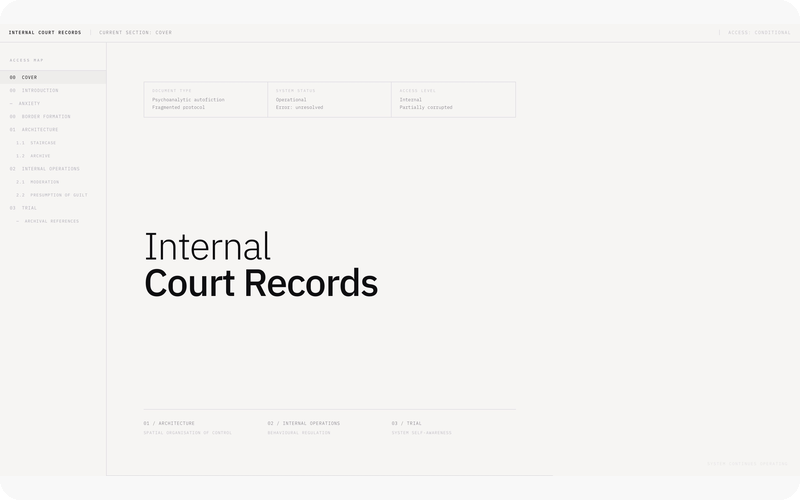
Internal Court Records is a fragmented work of psychoanalytic autofiction written through the language of institutional systems. The text treats anxiety, memory, and guilt not as emotions but as administrative structures. Psychological states become protocols: anxiety governs, memory archives, guilt prosecutes.
The work is structurally informed by Franz Kafka's administrative absurdity, Jacques Lacan's notion of internalised authority, and Michel Foucault's analysis of surveillance and self-regulation. Platform and algorithmic language — where moderation systems increasingly pre-structure subjectivity — is also a key reference.
Intended for readers of experimental fiction, psychoanalytic theory, and critical literature. Would appear in a theory journal, a contemporary art publication, or a hybrid platform for speculative writing.
Every state begins with a border. Mine began with anxiety. Constantly evaluating myself against the world, comparing, relying on my own perceived value — all became ways to contain the urge for control, to pacify anxiety.
Anxiety: my abyss, the native operating system of my internal drives. It established a vertical structure of power inside me long before I learned to distinguish my own desires. Around fourteen, when I was still assembling myself from fragments reflected in the shifting RGB static of the world. A benevolent dictator inspected sentences before they left my mouth, compared my life to others' the way a border officer checks documents.
Over time, I built an internal court. Its architecture became part of my personality.
The accusation appeared before the act itself. Not as a thought, not even as a voice — more like an internal contraction, a tension somewhere between the throat and the chest, as though the system prepared in advance for the necessity of justification.
I began explaining myself pre-emptively. Softening formulations. Reducing desires to a scale that would not trigger an internal alarm. This is how guilt ceases to function as a response to action and becomes a background condition.
The internal court never asked what I had done. It asked something else: What made you think you were allowed to begin with?