Group exhibition and individual essay working with the Chelsea College of Art archive. On archives, power, visibility, and what institutional memory chooses to erase.
UnitUnit 4 — Curatorial Ethics
FormGroup Exhibition + Individual Essay
ArchiveChelsea College of Art, 1960–2000
InstitutionUAL London College of Communication
nam3d
Chelsea College of Art Archive · 1960–2000
Exhibition Documentation
Context
The Project
[un]named is a group curatorial project working with the Chelsea College of Art archive — 5,154 digital and physical slides spanning 1960 to 2000, many without authorship, many never printed. The project asks: what does the archive preserve, and what does it choose to erase?
The exhibition arranges slides from named to unnamed, so the disappearance of information becomes physically legible rather than abstractly acknowledged. By inserting our own interpretive slides into the archive's format, we demonstrated that every archive — including ours — is a produced position.
"A thought once uttered is a lie."
— Fyodor Tyutchev, epigraph to the project
Essay — Excerpt
A Thought Once Uttered Is a Lie: On Archives, Power, and Curatorial Ethics
Opening argument
Tyutchev's phrase, "a thought once uttered is a lie," exposes the impossibility of capturing any moment in its full "truth." Applied to archives, this logic underpins my main argument: archives seek to preserve what is already lost but cannot avoid distortion. Examining the Chelsea College of Art's archive with 5,154 digital and physical slides, many without authorship, many never printed, reveals the futility of fixing memory.
Every archive is driven by a desire to resist disappearance. Yet, as Derrida's archival fever shows, the selective nature of documentation defeats this dream — producing erasure as much as preservation. My central claim is that the archive inevitably produces and conceals both presence and absence. Our ethical responsibility is to ask: whose memories does the archive protect, and whom does it erase?
On curatorial ethics
The ethical imperative is not to declare the archive complete, but to acknowledge its omissions, engage honestly with incomplete evidence, and understand that every curatorial choice reinforces or disrupts the existing logic.
Our ethical responsibility is not to fill the gaps, but to make them visible. To treat silence as evidence. To understand that every act of curation is also an act of power — and to exercise that power with honesty, accountability, and the knowledge that what we preserve today will become someone else's archive tomorrow.
Theoretical Framework
Key References
Derrida's archival fever · Foucault on power and documentation · Trouillot's four silences of historical production · Gramsci's hegemony · McLuhan's medium as message
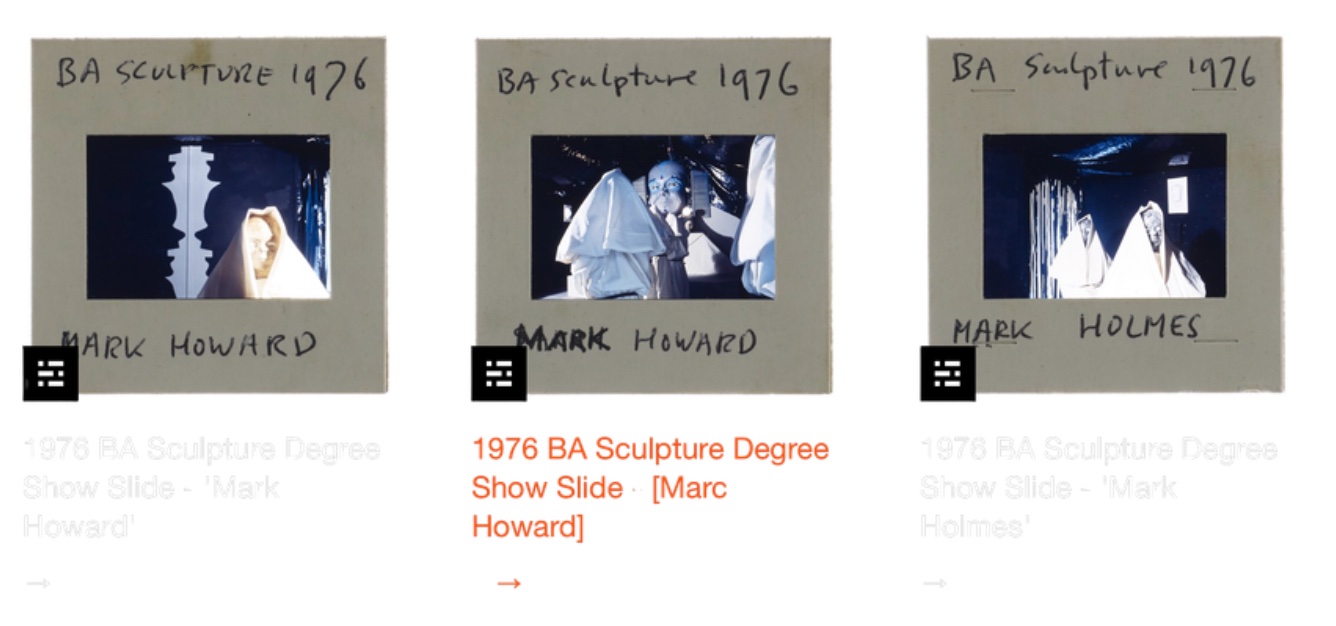
BA Sculpture Degree Show, 1976 · Photographic slides (series)
A series documenting an installation of masked, human-like figures. Defined by unusual density of documentation — repetition produces visibility. This raises the curatorial question: how should such material be approached when the archive amplifies certain works while others remain marginal or absent?
2 / 5
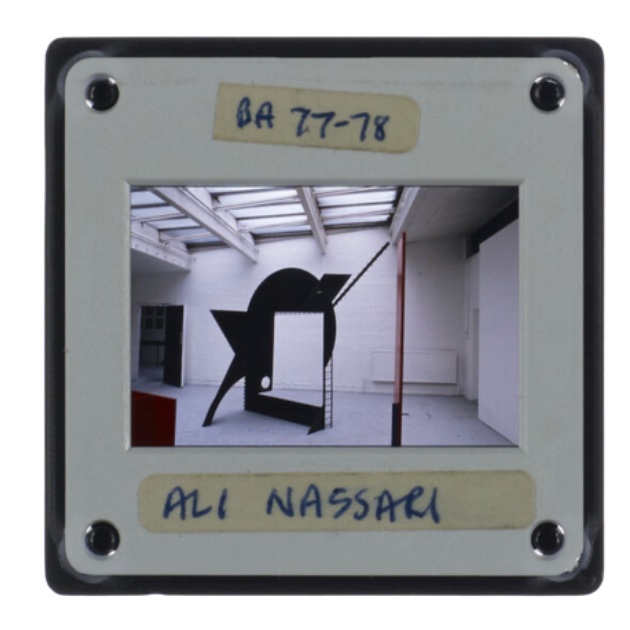
Ali Nassari
BA Sculpture Degree Show, 1978 · Photographic slide (35mm)
Dark angular geometric forms in a white studio. The slide reduces the work to a single controlled viewpoint, omitting scale, material, and spatial experience. How should such documentation be treated when it stabilises the image of a work while limiting the conditions through which it can be understood?
3 / 5
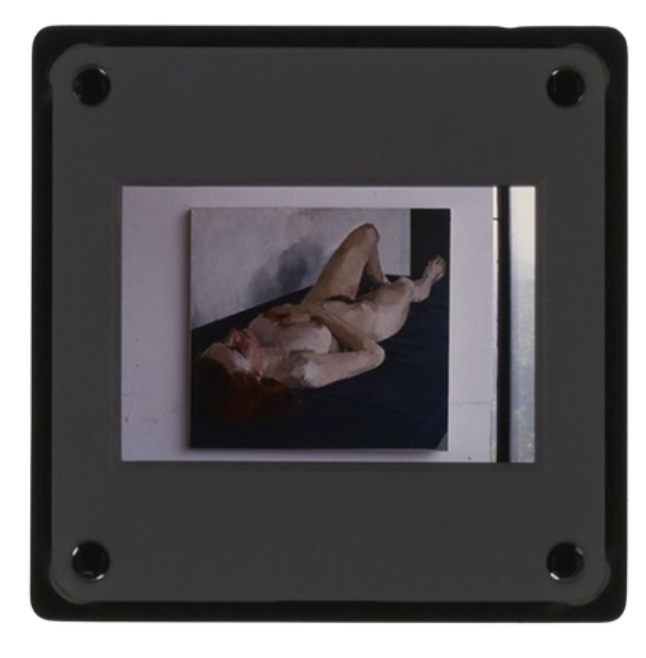
Unknown artist
BA Degree Show, 1982 · Photographic slide (35mm)
A painted reclining nude, attributed to an unknown creator — authorship reduced to absence while the image is preserved. The body remains visible, but its maker does not. What does it mean for an archive to preserve the image of a body while erasing the identity of the artist who produced it?
4 / 5
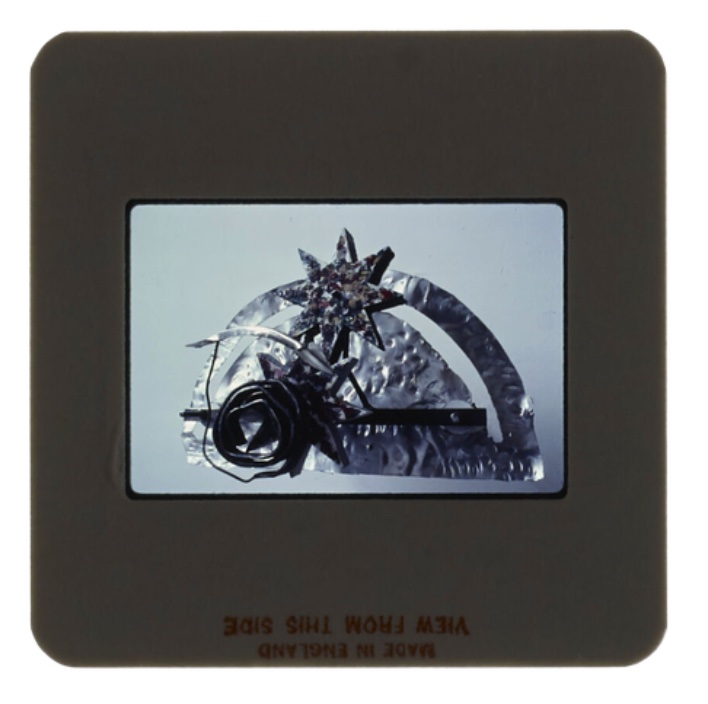
Unknown artist
BA Painting Degree Show, 1983 · Photographic slide (35mm)
The slide is upside down. Nobody corrected it. One of the more honest slides in the archive: the inversion makes visible what most slides conceal — that someone was behind the camera, working quickly, without a system. The archive did not happen to itself. Do you correct the slide and lose the evidence of how it was made — or leave it upside down, and let the error speak?
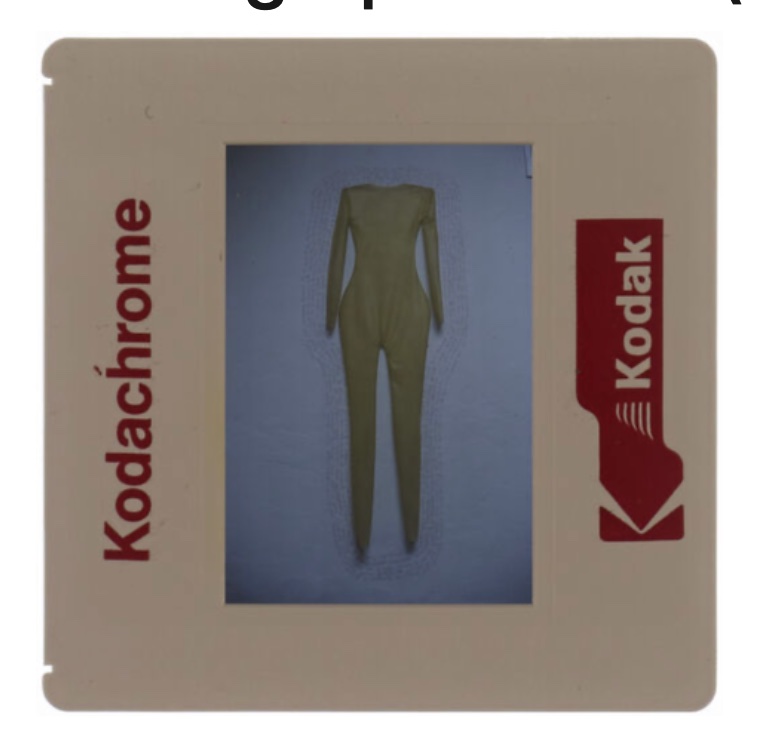
A yellow bodysuit hangs on a white wall — clothing as conceptual object. By 1995, British art education was shaped by the YBA generation and a turn toward the body as site of meaning. When a work is explicitly about the body, its presence, its politics — what does it mean that the body who made it has been erased from the record?
Bibliography
Derrida, J. (1996) Archive Fever: A Freudian Impression. Chicago: University of Chicago Press.
Foucault, M. (1972) The Archaeology of Knowledge. New York: Pantheon Books.
Forensic Architecture (2025) About. Available at: forensicarchitecture.org/about
Gramsci, A. (1971) Selections from the Prison Notebooks. London: Lawrence and Wishart.
McLuhan, M. (1964) Understanding Media: The Extensions of Man. New York: McGraw-Hill.
Trouillot, M.-R. (1995) Silencing the Past: Power and the Production of History. Boston: Beacon Press.